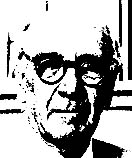

The third R D Fitzgerald studied science at the University of Sydney but did not complete his degree and instead turned to the profession of his father and grandfather. He hung his shingle in a Sydney city office where Philip Lindsay sometimes turned up in the morning, rather the worse for wear, to borrow a shilling for a cup of coffee. These visits were at first not welcomed by Fitzgerald's partner who was afraid that "this hobo" would frighten away potential custom. However when he discovered that they shared an interest in literature, it was the partner who often enough provided the shilling.
During the 1920s, FitzGerald collaborated (professionally but not recreationally) with the bohemian avant-garde who were inspired by Norman Lindsay. Two of Lindsay's sons provided a pen picture of the young R D at that time.
Impatience is his keynote, an impatience with flesh and bone, boisterously thumping his fist on the marble-topped tables of Mockbells [coffee shop], or the linoleum covering of a bar, while he insisted that Vision found a new school, the pre-Kiplingites, escape from the modern mathematics of verse, from the intellectual cottonwooling of emotion. Huge, lean, gaunt Fitz, with his bright dark eyes and tousled hair, striding down Pitt Street. I can see him now a theodolite tossed carelessly over one shoulder, roaring suddenly at sight of a friend, and swinging around, theodolite and all, so that had he been of ordinary height, he'd have brained at least a dozen passers-by; Fitz bellowing in the Angel or some other pub, or trying to fold his long legs under a restaurant table.
That was Phillip Lindsay's account, which FitzGerald repudiated (in part) on the grounds that he would never have been so careless with a precision instrument!
Jack Lindsay wrote in his memoire The Roaring Twenties that he liked Fitzgerald for his "engaging humility and ready mind, and perhaps it was only my liking that made me feel sure that his verses would get better. At that time they were rather tame. He did develop quickly, and so he was one of the few cases in which a wish of this kind came true".
Several of his first poems appeared in the short-lived journal Vision that was the vehicle for the Lindsay circle's highly idiosyncratic rejoinder to modernism. Another young contributor was Ken Slessor; these two took the lead through the later 1920s and 1930s to show Australian writers the way to a new maturity and poise. They were more serious and "literary" than the balladeers, without aggressive nationalism yet without deference to foreign models and especially without morbid and self-conscious introversion.
In the words of Jack Lindsay
Fitzgerald and Slessor were the poets who were to carry on in their own ways the impetus begotten by Vision and in the 1930s to dominate Australian poetry, lifting it definitively to a new level of intellectual responsibility and ending once for all the reign of the slipshod, the pedestrian and the emotionally inchoate.
During the 1930s FitzGerald spent several years in Fiji conducting surveys for the Native Lands Commission to pin down the vague traditional boundaries of the tribal lands. Most of that time he was the only European in the vicinity and he wrote (too briefly) some charming memoires of those times. Back in Australia he worked as a municipal surveyor with the councils of Manly and Ryde until he joined the Commonwealth Department of the Interior in 1940 and surveyed sites for wartime aerodromes. By the time he retired in 1965 he had become the supervising surveyor of the NSW branch of the department.
His first collection of verse consisted of short poems, unified by the theme of man torn between the opposing attractions of the transcendent reality (the Greater Apollo) and the material world. His second collection with thirty-three poems, including The Greater Apollo series won a significant award in Britain. Due to the demands of his work in Fiji during the 1930s his third collection did not appear until 1938. This included The Hidden Bole, a long and intricately constructed elegy on the transience of beauty, using as examples the banyan tree and the ballerina, Pavlova.
Heemskerck Shoals contains short poems and a long dramatic monologue inspired by the almost disastrous Fijian experience of the Dutch explorer Abel Tasman who encountered a reef, which he named Heemskerck Shoals near Nanuku Island in Fiji. The monologue, in irregular rhymes and half-rhymes concerns the frustrated ambition of Tasman and his obsession with the lost opportunities presented by the continent of Australia. FitzGerald depicted a character who combined elements of the imaginative dreamer and the practical man of action. His next collection included a long poem which he wrote over a period of many years, an ambitious five part narrative and meditation based on the remarkable saga of a young seaman who was adopted by a Tongan chief after his ship was burned and the crew massacred by the natives in 1806. Focussed on the evolving relationship between the sailor and the chief, the poem has a theme of action and the need for "acts of resolution" while a subtext is the transience of life, lasting only "between two tides" before the evidence of our presence is washed away, like footsteps in the sand.
Much of FitzGerald's poetry was not published in book form until the 1950s, partly because he frequently revisited old poems to improve them. This Nights Orbit contained two important poems, The Face of the Waters, a meditation on the Creation and Fifth Day, an incident from the trial of Warren Hastings. He was the first Govenor-General of India (1773-1784) and he was impeached for allegations of extortion against several of the local rulers. The prosecution, led by Edmund Burke, lasted ten years and Hastings was vindicated but financially ruined. The record of the proceedings was taken in shorthand by the court reporter Gurney and FitzGerald discovered the event in the course of researching various forms of shorthand, which happened to be one of his interests.
In 1965 he published a collection Forty Years Poems containing most of his later work and a section titled "Salvages" with that portion of his earlier poems, which he wished to retain.
During the 1950s and 1960s FitzGerald was something of an elder statesmen among Australian writers and he exerted a deal of influence by reviewing and occasional lectures in addition to the example that the set with his own poetry. His influence was beneficial especially in the balance and moderation that he brought to the "National-International" debate, the longstanding conflict about how distinctively Australian our literature should be. On the National side stood the Bulletin writers of the 1890s and those of the Vance Palmer group and the Jindyworobaks who sought to emulate them. On the other side are those who question whether a self-consciously Australian tradition has any relevance to young writers. Fitzgerald envisaged the two strands of national and international literature converging into a broader stream. In a 1967 article "Nationalism and Internationalism" he wrote:
I do not really foresee any dirty greyness of uniformity as a result of the loss of an independence which already does not really existWe take pleasure in the Australianity of our literature. We like it, though we must never accept it as a sole test. If we were ever to lose it or deliberately abandon it, Literature in English could lose a great part of its flavour: something of that greyness would descend.
One of the themes that appears from time to time in his poetry was identified by H M Green but is not generally noted. That is FitzGerald's interest in scientific exploration and the frontiers of knowledge, as well as adventures in the life of action. Green reported that FitzGerald was deeply influenced in his middle period (the 1930s) by reading Alfred North Whitehead's book Science and the Modern World. This endorsed his own view on the need to combine an interest in particulars with general speculation about the human condition. Fitzgerald's interest in the adventure of ideas and action is manifest in his poem Beginnings.
not to have watched Cook
drawing thin lines across
the last sea's uncut book
is my certain loss;
as too is having come late,
the other side of the dark
from that bearded, sedate
Hargrave of Stanwell Park
and so to have missed, some bright
morning in the salty, stiff
north-easter, a crank with a kite-
steadied above a cliff.
Hargrave was an Australian inventor and an important pioneer in flight who almost produced a flying machine before the more famous Wright brothers.
Critical judgements on Fitzgerald have been mixed, ranging from H M Green's enthusiastic endorsement of his achievement to more recent commentators who have noted a number of limitations "ungainly, lacking in lyricism, grace and spontaneity". He was never popular or fashionable as indeed a serious literary writer in Australia could never hope to be in his time. Not surprisingly, self-consciously modern poets have little use for a relatively conservative figure who used his poetry to address complex, philosophical ideas and for the examination of abstract, intellectual concepts. James McAuley was also prepared to mix ideas with his poetry (and to write epic poems about explorers) but he was not a great admirer of FitzGerald. He wrote
The difficulty felt by many readers is that, if one looks at the work as an artistic achievement, it becomes necessary to bring in aid a conviction of the value and importance of the ideas; and if one looks at the ideas, it becomes necessary to bring in aid a conviction of the artistic worth of their embodiment.
No doubt the reputation that FitzGerald enjoyed from the late 1930s to the 1960s (aided by sympathetic commentators such as Green and his friend Douglas Stewart) has lately diminished. However he still has admirers among those who appreciate his integrity, his craftsmanship, his vision, his sustained productivity and the quality of his best work.